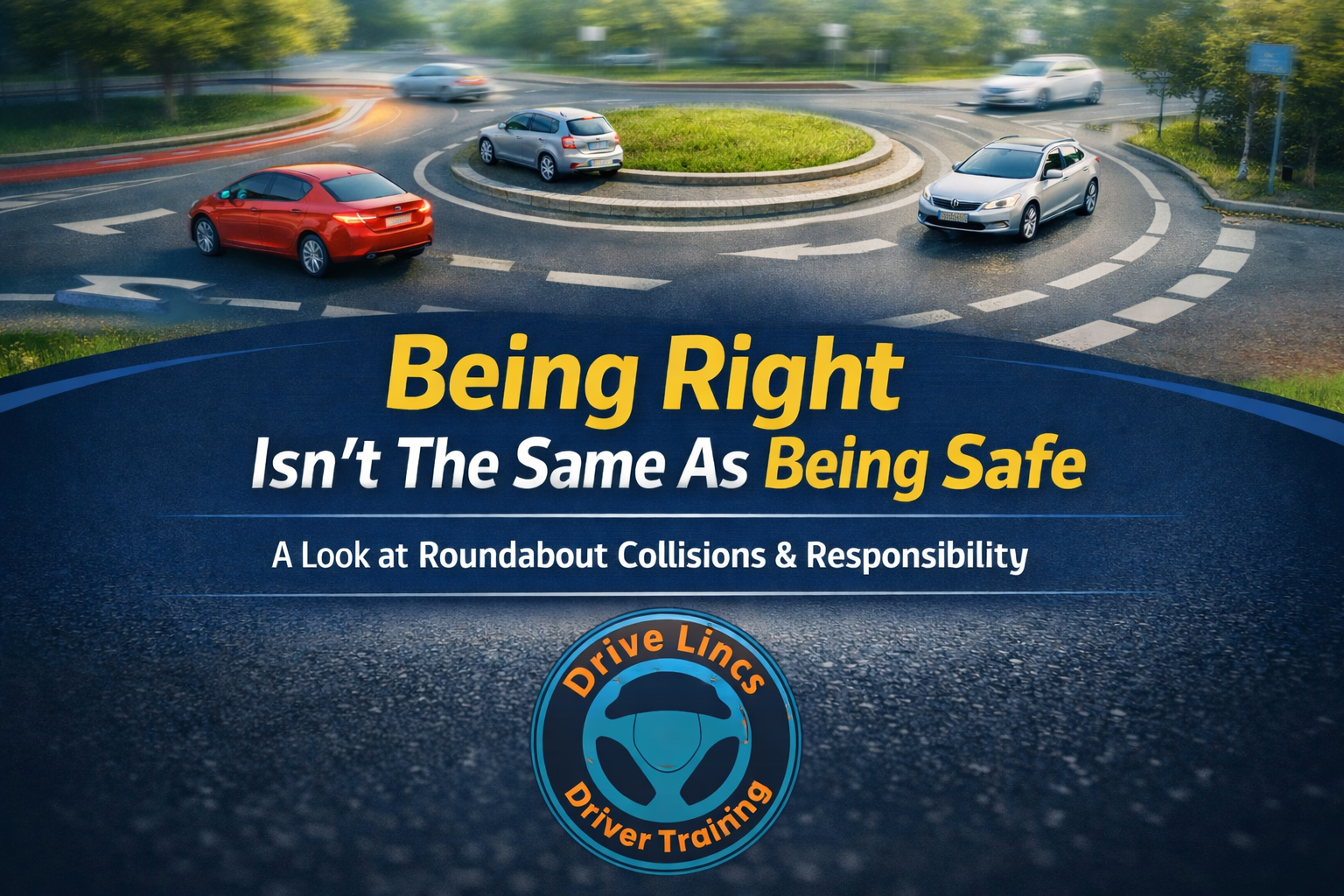
Being Right Isn’t the Same as Being Safe
A Perspective for All Drivers on Roundabouts
There is a moment that most drivers will recognise.
You approach a roundabout. You have chosen your lane. You know where you are going. Maybe you have driven this route many times before. It feels routine, familiar and safe.
And then something unexpected happens.
Another driver drifts out of their lane. Someone hesitates when they should not. Or worse, they commit when they should not. Suddenly everything changes in a split second.
The reality is that most collisions on roundabouts do not happen because people are reckless. They happen because people are human.
Driving on Autopilot
Most drivers are not careless. They are simply getting on with their day.
They are thinking about work. Running late. Planning what comes next. Replaying something in their mind.
Driving becomes something we do rather than something we fully think about.
That works most of the time. Until it does not.
Roundabouts demand more. They require attention, awareness and quick decisions, often all at once.
And when drivers are on autopilot, that is where things start to go wrong.
The Illusion of Control
There is a common belief many drivers carry.
I am in the correct lane. I have done everything properly. I will be fine.
From a rules point of view, that may be true.
But the road does not operate on rules alone in the moment. It operates on human behaviour.
At a roundabout you are not just managing your own decisions. You are dealing with multiple drivers, all with different levels of experience, confidence and familiarity with the layout.
Some drivers know the roundabout well. Others are seeing it for the first time and trying to work it out as they approach.
That is not a level playing field.
Assumption Versus Awareness
One of the most important distinctions any driver can make is the difference between assumption and awareness.
Assumption is believing that other road users will do what they are supposed to do.
Awareness is preparing for the possibility that they will not.
On a roundabout, assumption sounds like this. They are in the left lane so they will be turning left.
Awareness sounds like this. They should be turning left, but what if they do not.
That small shift in thinking can be the difference between a safe journey and a collision.
Why Being Right Can Still Lead to a Collision
It might feel unfair, but it is important to be clear.
You can be completely in the right and still be involved in a crash.
On roundabouts, responsibility is often shared. Not because both drivers made the same mistake, but because both may have had an opportunity to prevent what happened.
In fact, previous legal cases such as Grace v Tanner have helped establish an important principle. Even when one driver has priority, there is still an ongoing responsibility to take reasonable care and to avoid a developing situation if possible.
That can be frustrating, especially if you know you followed the rules.
But in real world driving, the key question is not simply who was right.
The question is whether the situation could have been recognised and avoided.
A Different Driving Mindset
This is where a shift in thinking makes a real difference.
Instead of asking who has priority, ask what leads to the safest outcome.
Because sometimes the safest decision does not look like the correct one.
It might mean slowing down earlier than expected. It might mean giving space to another driver. It might even mean taking the wrong exit and correcting your route afterwards.
There can be a strong urge to hold position, especially when you know you are right.
But it is worth asking a simple question.
Would you rather arrive ten minutes late, or risk not arriving at all
The Shared Nature of the Road
The road is a shared environment.
Every driver brings different levels of experience, confidence and understanding. Some will make good decisions. Some will make poor ones. Most will do a bit of both.
On roundabouts, those differences come together very quickly.
A moment of patience, a small adjustment, or a decision to give way when you do not have to can prevent a collision from happening.
These are not signs of weakness. They are signs of awareness and control.
A Final Thought
Being right does not keep you safe.
Awareness keeps you safe.
Understanding that other drivers may make mistakes keeps you safe.
And choosing to avoid a developing situation, even when you feel justified, is often the best decision you can make.
Because at the end of the day, getting to your destination safely matters more than proving a point.